Guide
Which joint is which
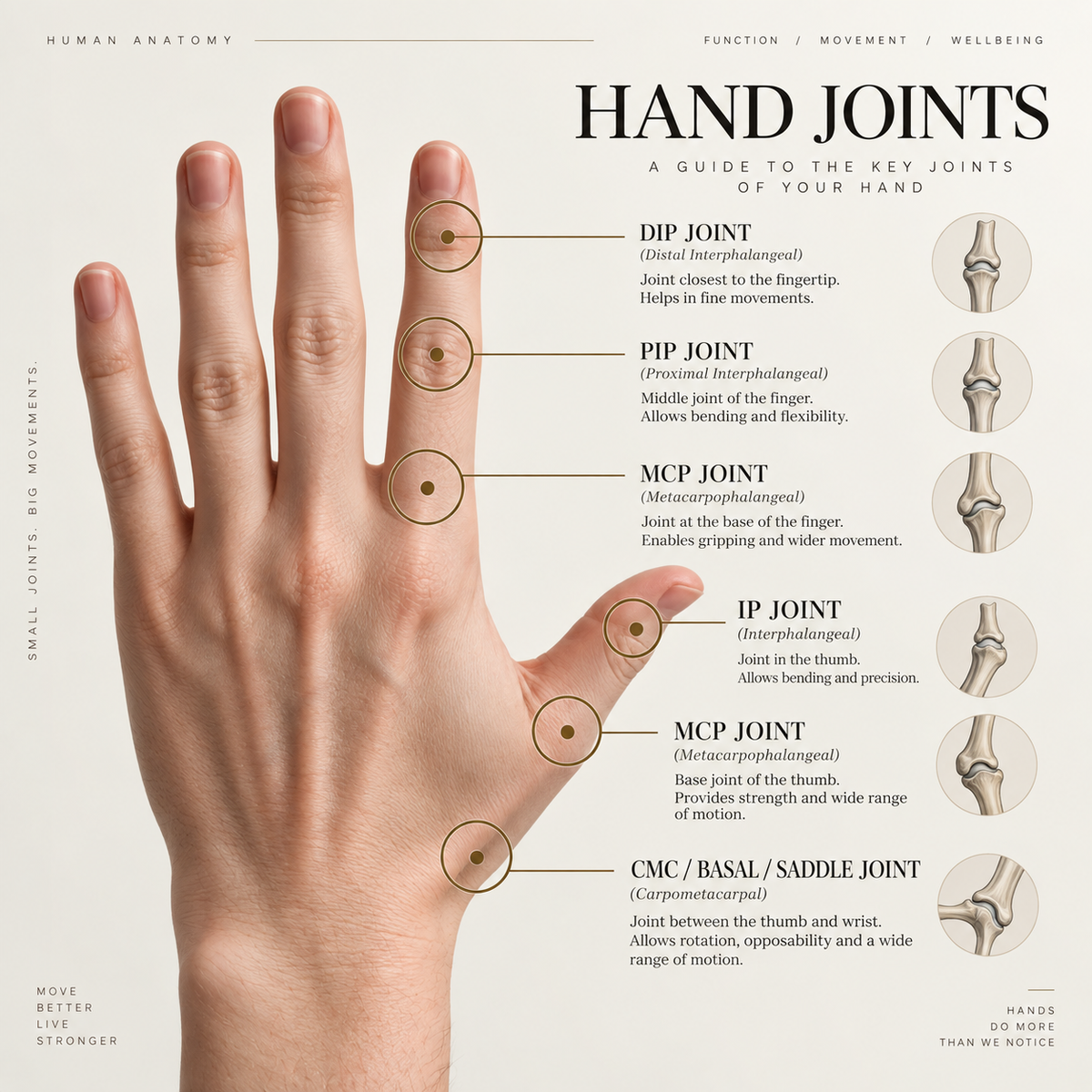
DIP, PIP, MCP, IP and CMC, shown on a real hand. Every RING ORTHO design is made for a specific joint or area.
The finger
- DIP jointDistal interphalangeal
- The joint closest to the fingertip. Helps in fine movements.
- PIP jointProximal interphalangeal
- The middle joint of the finger. Allows bending and flexibility.
- MCP jointMetacarpophalangeal
- The joint at the base of the finger. Enables gripping and wider movement.
The thumb
- IP jointInterphalangeal
- The joint in the thumb. Allows bending and precision.
- MCP jointMetacarpophalangeal
- The base joint of the thumb. Provides strength and a wide range of motion.
- CMC jointCarpometacarpal, also called the basal or saddle joint
- The joint between the thumb and the wrist. Allows rotation, opposability and a wide range of motion.
Designs by joint
Each line below comes from the product page. Open a design to read its full description, fit notes and clinical considerations.
PIP joint, the middle joint of the finger
- Swan Neck SplintA finger ring splint designed around the PIP joint, the middle joint of the finger.
- Boutonniere Finger SplintA longer finger ring splint designed around the PIP joint, the middle joint of the finger.
- Boutonniere Lateral Support SplintA finger ring splint with lateral support and a dorsal spacer, designed around the PIP joint.
- Long Boutonniere SplintAn extended finger ring splint designed around the PIP joint.
- Lateral Support Finger SplintUsed on the PIP and DIP joints.
DIP joint, closest to the fingertip
- Lateral Support Finger SplintUsed on the PIP and DIP joints.
Base of the finger
- Pulley RingA wide, smooth finger band worn at the base of the finger.
Between fingers
- Buddy RingA buddy ring that joins two adjacent fingers in one connected piece.
- 2½ Buddy RingA buddy ring that brings adjacent fingers together at the MP joint level.
Thumb IP joint
- Spiral SplintA spiral ring splint designed around the thumb IP joint, the joint nearest the tip of the thumb.
Thumb MCP joint
- Thumb MCP SplintA fine wire thumb splint designed around the thumb MCP joint, the base joint of the thumb.
- Thumb MCP Splint with BraceletA thumb ring connected to a wrist bracelet, designed around the thumb MCP joint.
- Stable Thumb SplintA structured thumb splint with a textured plate, designed around the thumb MCP joint.
Why the joint matters for fit
Designs for the DIP, PIP and thumb IP joints pass over a joint. That is why they ask for two ring sizes: one above the joint and one below it.
More guides
Important RING ORTHO pieces are functional jewelry and not a substitute for advice from a qualified hand therapist or healthcare professional.